Published by:
CGP EDU Academic Team
Published on: September 12, 2026
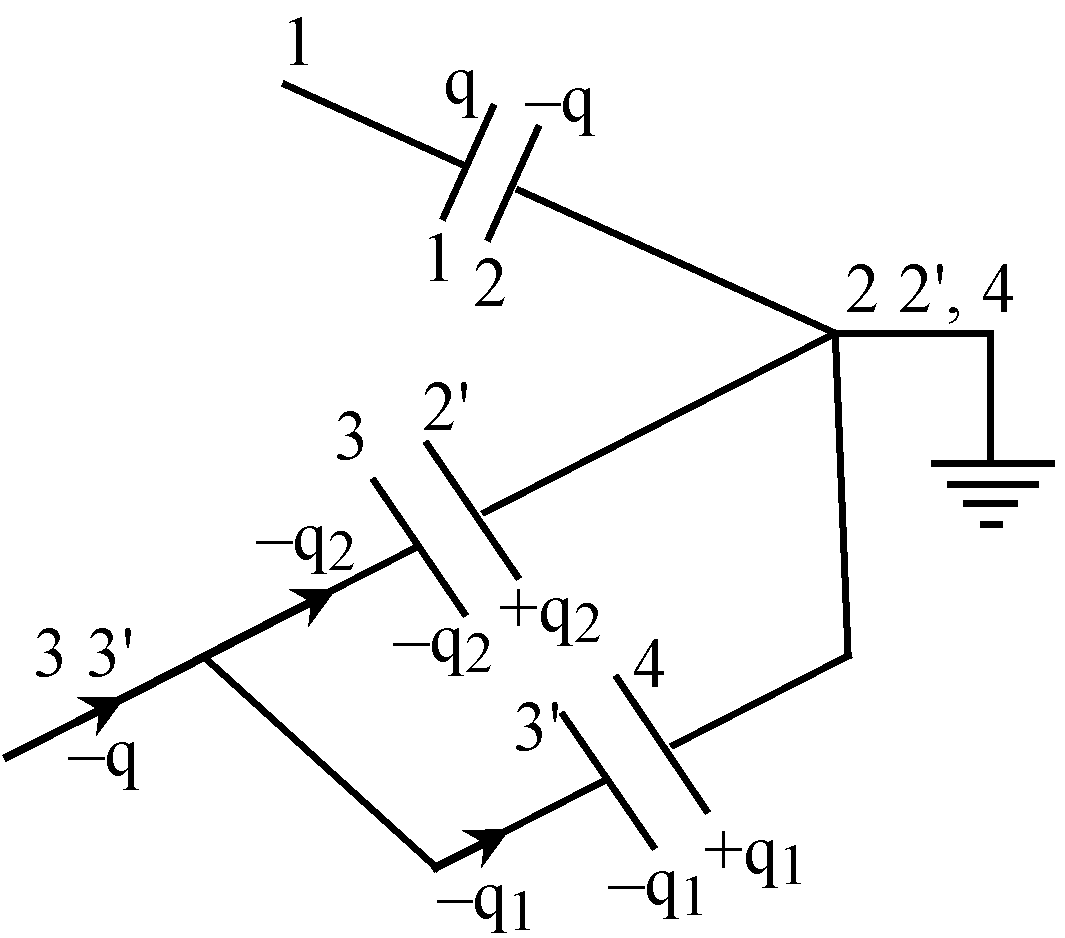
Figure show three concentric thin spherical shell A, B and C of radii a, b and c respectively. The shell A and C are given charges q and –q respectively and the shell B is earthed. Find the charges appearing on the outer surfaces of B and C.

Text Solution
Verified by ExpertsThe correct answer is:
B
Step 1: Understanding the system
We have three concentric spherical shells A, B, and C with charges q, 0, and -q, respectively. Shell B is earthed, meaning it is at zero potential.
Step 2: Charge distribution
Since the electric field inside a charged conductor is zero, the charge on shell B must redistribute itself to maintain this condition. Given that shell A has a charge q and shell C has a charge -q, they influence the charge on shell B.
Step 3: Calculating the charge on shell B
The net charge on shell A (+q) induces an equal and opposite charge on the inner surface of shell B. Hence, there will be a -q charge on the inner surface of shell B. Since B is earthed, the total charge on the outer surface of B must balance it out.
Let the charge on the outer surface of shell B be Q_B. The total charge on shell B is zero, hence:
0 = Q_B - q
Therefore,
Q_B = +q.
Step 4: Charge on outer surface of shell C
Since shell C has a charge of -q and the inner surface of shell C must balance the charge on the inner surface of shell B, it must have a charge of +q on its inner surface. Therefore, the total charge on the outer surface of shell C will be:
Q_C = -q (total charge of shell C) - (+q) (induced charge on the inner surface) = -2q.
Conclusion
Thus, the charges appearing on the outer surfaces of shells B and C are +q and -2q, respectively.
We have three concentric spherical shells A, B, and C with charges q, 0, and -q, respectively. Shell B is earthed, meaning it is at zero potential.
Step 2: Charge distribution
Since the electric field inside a charged conductor is zero, the charge on shell B must redistribute itself to maintain this condition. Given that shell A has a charge q and shell C has a charge -q, they influence the charge on shell B.
Step 3: Calculating the charge on shell B
The net charge on shell A (+q) induces an equal and opposite charge on the inner surface of shell B. Hence, there will be a -q charge on the inner surface of shell B. Since B is earthed, the total charge on the outer surface of B must balance it out.
Let the charge on the outer surface of shell B be Q_B. The total charge on shell B is zero, hence:
0 = Q_B - q
Therefore,
Q_B = +q.
Step 4: Charge on outer surface of shell C
Since shell C has a charge of -q and the inner surface of shell C must balance the charge on the inner surface of shell B, it must have a charge of +q on its inner surface. Therefore, the total charge on the outer surface of shell C will be:
Q_C = -q (total charge of shell C) - (+q) (induced charge on the inner surface) = -2q.
Conclusion
Thus, the charges appearing on the outer surfaces of shells B and C are +q and -2q, respectively.
Prepare Smarter with CGP Edu
Get practice questions, solutions, and test series in one place.
Write a Review
Share your experience with this question and solution.
Commentary
Send your comment, doubt, correction, or feedback to admin.
Similar Questions
Explore conceptually related problems
The law, governing the force between electric charges is known as
When the distance between the charged particles is halved, the force between them becomes
There are two charges +1 microcoulombs and +5 microcoulombs. The ratio of the forces acting on them…
A charge q 1 exerts some force on a second charge q 2 . If third charge q 3 is brought near, the fo…
$F_g$ and $F_e$ represents gravitational and electrostatic force respectively between electrons sit…
The ratio of the forces between two small spheres with constant charge (a) in air $(b)$ in a medium…